


Short answer
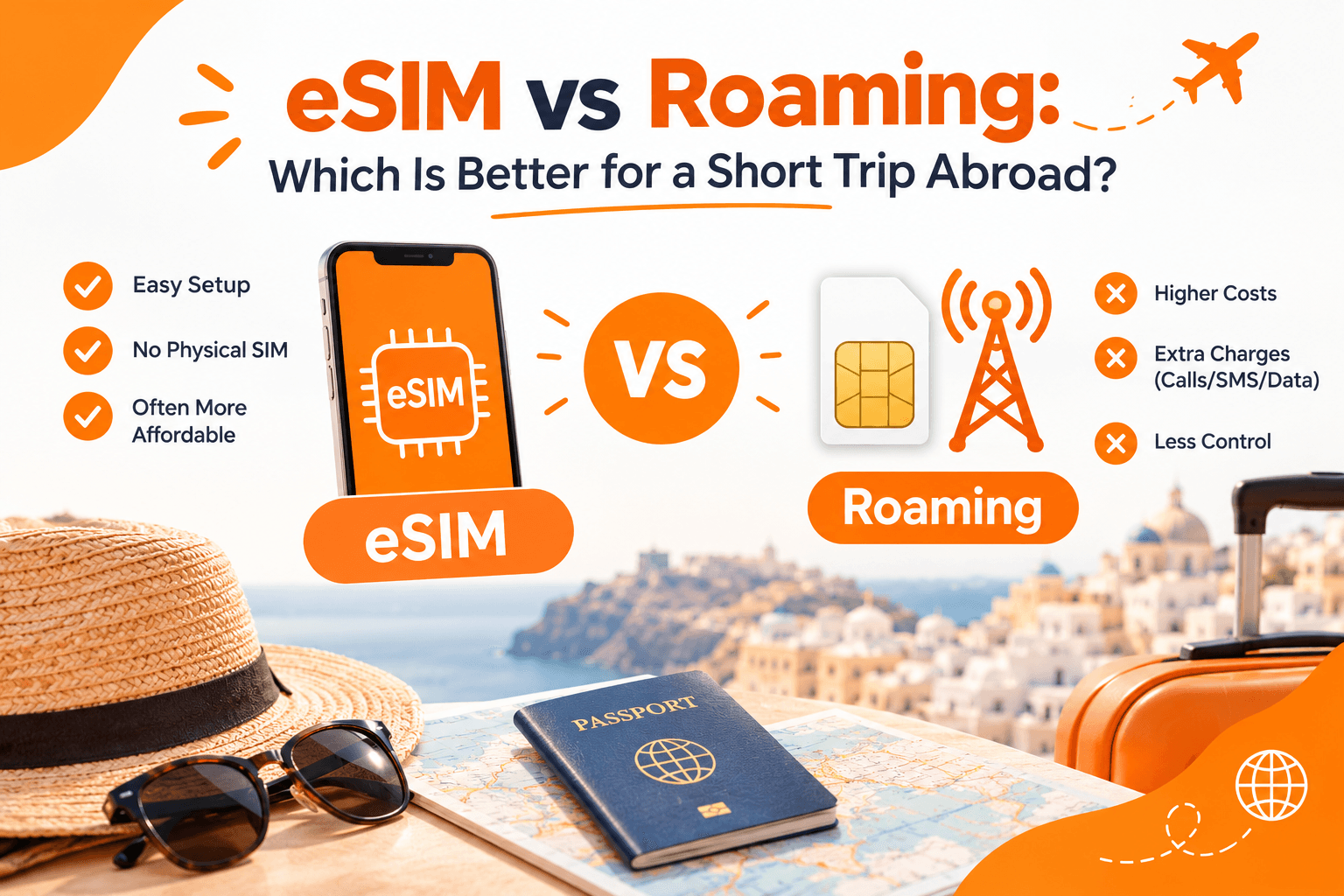
For most short trips, a travel eSIM is the better pick. It costs less than a daily roaming pass once you are away more than a couple of days, and you set it up before you fly. Roaming wins only for very short stays, or when your home plan already includes the country you are visiting.
You land, switch off airplane mode, and a text arrives from your home carrier. It says data roaming is on and charges apply. You have no idea what a megabyte costs here, and you still need a map to find your hotel.
This is the choice every short trip comes down to: pay your home carrier to roam, or bring a travel eSIM. Both work. They suit different trips, and for a few trips roaming is the right call. Here is how to tell which one is yours.
How roaming works on a short trip
Roaming means your normal SIM borrows a local network in the country you are visiting. Your home carrier pays that network, then passes the cost on to you. Nothing to buy, nothing to install. You land and it simply works.
That ease is the whole appeal. But the cost depends entirely on how your carrier sells it. There are usually three versions:
- Pay per megabyte. This is the expensive one. A few minutes of maps and photos can use more than you expect, and the bill arrives after you are home.
- A daily pass. You pay a fixed fee for each day you use data abroad. It is predictable, but the days add up fast on a week-long trip.
- Roaming included in your plan. Some plans cover certain countries at no extra cost, often a neighbouring region. If yours does, this is hard to beat.
One more thing to know. Daily passes often switch on the moment your phone touches any data, even a background app update. You can be charged for a day you barely used.
How a travel eSIM works on a short trip
An eSIM is a SIM built into your phone, so there is no small plastic card to swap. People often search for it as an eSIM card or an e sim, but nothing physical arrives. You buy a plan online and get a QR code by email. You scan it, and the plan sits on your phone ready to use.
A travel eSIM gives you mobile data only. Your own SIM stays in the phone, so your home number does not change. Calls and texts to that number still arrive if your carrier allows them abroad. Apps like WhatsApp work over the eSIM data, which we cover in our guide to WhatsApp and calls on a travel eSIM.
You pay once, for a set amount of data and a set number of days. When the data or the days run out, the plan stops. There is no bill waiting for you later. You can install it before you fly and switch it on when you land.
The weak spots are real, though. Your phone must support eSIM, and you have to do a few minutes of setup at home. If you leave it until arrivals, you need Wi-Fi to download the plan, which is why buying before you fly is the safer habit.
eSIM vs roaming, side by side
| What matters | Home carrier roaming | Travel eSIM |
|---|---|---|
| Setup | None, or one text to your carrier | A few minutes at home |
| How you pay | Per megabyte, per day, or included | One fixed price for the plan |
| Surprise bills | Possible, mostly on pay-per-megabyte | No, the plan simply ends |
| Your home number | Calls and texts work as normal | Stays on your own SIM, which remains in the phone |
| Phone needed | Any phone | One that supports eSIM |
| Online the minute you land | Yes | Yes, if installed before you fly |
| Sharing data with a laptop | Often limited or blocked on roaming passes | Depends on the plan, so check first |
When roaming is the better pick
It would be dishonest to say an eSIM always wins. Roaming is the better choice in three situations.
Your plan already covers the country. If your carrier lists your destination as included, paying for a second plan makes no sense. Check the roaming page on your carrier's site, or call them, before you spend anything.
The trip is a day or two. A single daily pass can cost less than a whole eSIM plan. For a quick overnight work trip, roaming is often simpler.
Your phone does not support eSIM. Older phones cannot use one at all. You can check on our list of eSIM compatible phones, or look in your phone settings for an option to add a mobile plan.
When a travel eSIM is the better pick
Past two or three days, the maths usually turns. A daily roaming pass charges you for every day, whether you use ten minutes or ten hours. A travel eSIM plan is built around the whole trip.
It also saves you the hunt at the airport. Most big airports have SIM counters in the arrivals hall, past baggage reclaim. After a long flight the queue can run twenty minutes or more. The staff will ask for your passport, and you walk out holding a plastic SIM you must swap in with a pin, while your home SIM sits in your pocket. With an eSIM, you were already online before you reached the belt.
It is also cleaner if you travel with others. A family of four can each have their own plan without anyone passing a hotspot around. And if you wonder how much data you will really use, our guide to estimating data use abroad gives you real figures to size a plan.
Whichever you choose, switch off data roaming on your own SIM before you land if you are using an eSIM for data. That one setting stops your home carrier from charging you in the background.
Which one suits you
The weekend city break
If you are away two nights and your carrier sells a cheap daily pass, roaming is fine. If you need maps, ride apps and messages all weekend, a small eSIM plan is usually still cheaper and does not need you to remember to switch anything off.
The one-week holiday
This is where an eSIM wins most clearly. Seven daily passes add up, while one plan covers the whole week. Pick the data amount first, then the number of days.
The business traveller
You may want your normal number for calls and a steady connection for email. Keep your own SIM in place, add an eSIM for data, and check whether your company already pays for roaming. If it does, use that.
The multi-country trip
Roaming rates change from one country to the next, which makes costs hard to predict. A regional plan that covers every country on your route keeps it to one purchase and one line on your phone.
Do
Check your carrier's roaming page and your phone's eSIM support before you buy anything.
Do not
Land with roaming switched on and no idea what your carrier charges per day.
Two checks before you decide
First, find out what your carrier really charges. Do not guess. Look up the roaming rate for your destination, and note whether it is per day or per megabyte.
Second, check your phone supports eSIM, and that it is not tied to your carrier in a way that blocks new plans. If you are unsure, the answers to the most common setup questions are in our frequently asked questions.
The plain verdict
Roaming asks nothing of you before the trip and can cost a lot after it. A travel eSIM asks for a few minutes at home and gives you a fixed cost. For anything longer than a quick overnight stay, most travellers come out ahead with the eSIM.
If your own plan already includes where you are going, use that and save your money. Otherwise, set up the eSIM the week before you fly, so the airport is the easy part.


