


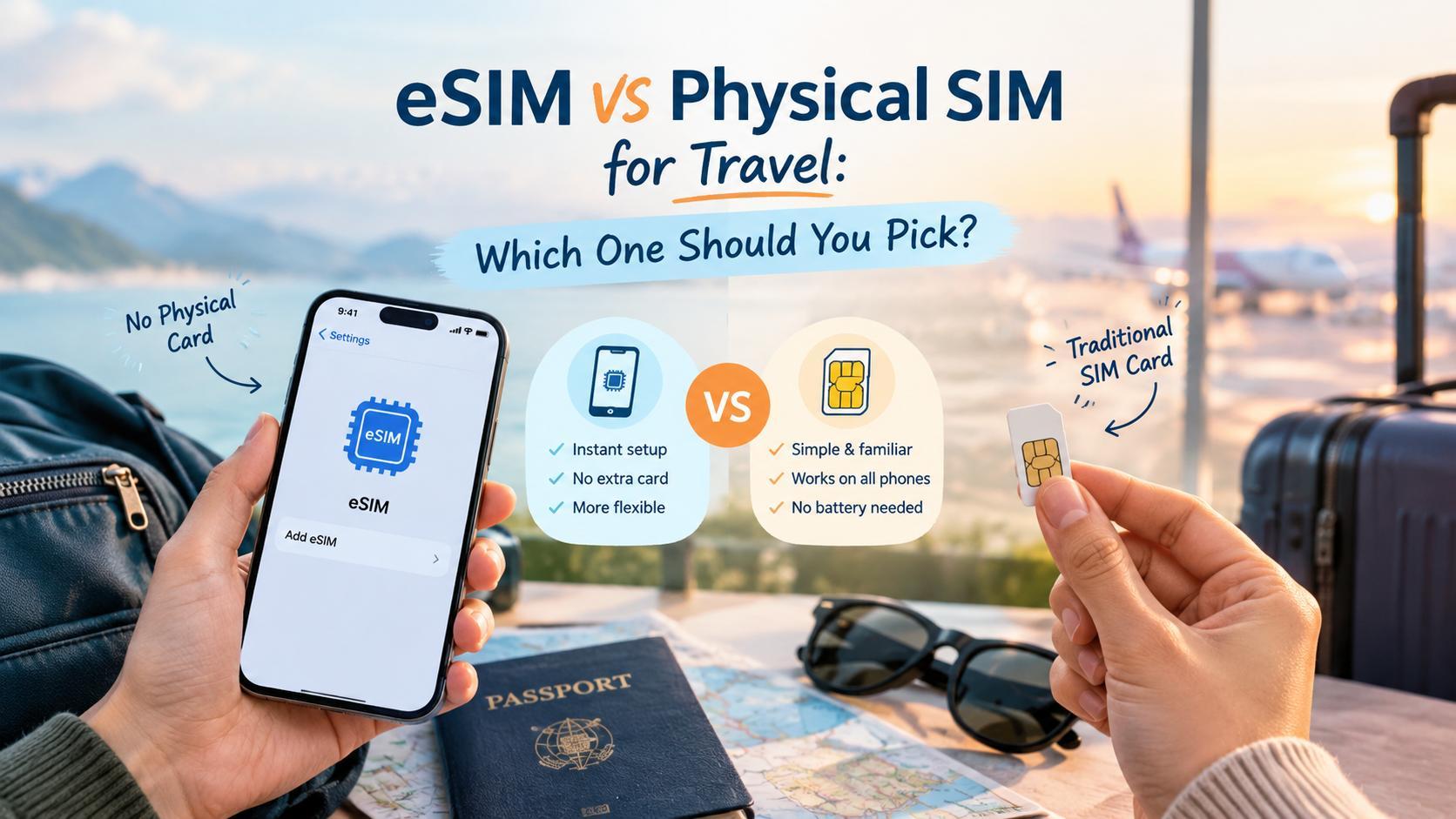
eSIM or physical SIM: what are you actually choosing between?
You land in a new country, and your phone needs data within the hour. You can pay your home network's roaming rate, which is often the most expensive option. Or you can pick a travel eSIM or a physical SIM card. Most people do not know which one to choose.
Here is the plain answer. If your phone supports eSIM, a travel eSIM bought before you fly is usually easier. If your phone does not support it, or you need a local phone number, a physical SIM is the better pick. The rest of this article explains why, and where each one lets you down.
Both options do the same job: they connect your phone to a local network so you pay local data prices, not roaming prices. The difference is how the connection gets onto your phone.
What a physical SIM is
This is the small plastic card you already know. You slide it into a tray on the side of your phone, using a pin. You usually buy it in the country you are visiting, from a kiosk, a phone shop or an airport counter. Some shops also post one to you before the trip.
What an eSIM is
An eSIM is a SIM built into your phone, so there is no card to swap. People often search for it as an "eSIM card" or an "e sim", but nothing physical ever arrives. You buy a plan online, scan a QR code or tap a link, and your phone adds the plan in a couple of minutes. Our guide on how to install an eSIM shows the exact taps.
The differences that matter on a trip
Most comparisons list a dozen points. Only a few change what happens on your trip. Here they are side by side.
| Question | Travel eSIM | Physical SIM |
|---|---|---|
| Where you get it | Online, from your sofa | A shop or counter, or by post |
| Ready when you land | Yes, if installed before you fly | Only after you find a seller and queue |
| Needs a phone that supports it | Yes, and the phone must not be locked to one network | Almost any phone with a SIM tray |
| Your home SIM | Stays in, so you keep your usual number | Often has to come out, unless your phone has two SIM trays |
| Local phone number | Many travel plans are data only, so check the plan page | Usually yes, with local calls and texts |
| Passport or ID at purchase | Usually not | Often required, as many countries register SIMs to a passport |
| If you lose the phone | The plan is tied to that phone | You can move the card to another phone |
When a physical SIM is the better pick
We sell eSIMs, so it would be easy to say they win every time. They do not. Here are the cases where a card is the smarter choice.
Your phone cannot use an eSIM
Many phones sold before 2018 have no eSIM support. So do some cheaper models. Check yours on the eSIM compatible device list before you buy anything. If it is not on the list, a card is your only choice.
Your phone is locked to your home network
A carrier lock means your phone only accepts SIMs from the network that sold it. A locked phone often refuses a travel eSIM as well as a foreign card. Your home network can tell you if it is locked, and can usually unlock it if you ask. Do this before the trip, not at the airport.
You need a local number for calls
Some people need a number in the country they are visiting: for a landlord, a delivery driver, or a restaurant that confirms bookings by text. A local SIM gives you that. Most travel eSIM plans are built for data, and calls go through apps such as WhatsApp instead. Our post on WhatsApp and calls with a travel eSIM explains what works.
You are staying for months
If you are moving somewhere for a season, a local SIM with a monthly plan can work out better value. You will want a local number for banks and bills anyway. A short trip is a different case.
When an eSIM is the better pick
The strongest point for an eSIM is timing. Picture the arrivals hall at Bangkok Suvarnabhumi after a long flight. There are SIM counters with queues, a passport to hand over, and a tired head trying to compare plans. With an eSIM already installed, you switch it on when the plane lands and walk straight past.
That one habit, installing before you fly, is the main reason eSIMs are popular. We cover it in detail in why before you fly is better than after you land.
Other reasons an eSIM wins:
- You keep your home SIM in the phone, so calls and texts to your usual number still arrive. Nothing to swap, nothing tiny to drop down a drain.
- You can use a second SIM at all, even on a phone with one SIM tray, because the eSIM sits beside the card.
- You can visit several countries on one plan, if you choose a regional plan. A physical SIM usually works in one country only.
- You pay for the plan online. No cash, no counter, no price you only learn at the till.
What both options cannot fix
Neither one gives you better signal than the local network can offer. In a mountain valley or on a remote island, both will struggle. The plan size matters too. Two weeks of maps, messages and a few video calls needs more data than people expect, and our guide to how much data you need abroad helps you pick.
A word on price. Airport SIM counters often charge more than shops in town, though this varies by country. An eSIM plan is shown clearly before you pay. You can see every option on the plans page, and the prices you see there follow your location.
Which one suits which traveller
One-week holiday, newer phone
Travel eSIM. You land connected and keep your normal number.
Several countries in one trip
Travel eSIM on a regional plan. One install, no new card at each border.
Older phone, no eSIM support
Physical SIM. Buy it in town if you can, not at the airport.
Business trip with local calls
Either, but check the plan covers calls. A local SIM is simplest if you need a local number.
Moving abroad for months
Physical local SIM on a monthly plan, with an eSIM for the first few days.
Check these three things before you decide
Before you buy anything
✓ Your phone supports eSIM. Look it up in the list of phones that support eSIM.
✓ Your phone is not locked to your home network.
✓ You know whether you need a local number or only data.
So, which is better?
For most trips of a few days to a few weeks, a travel eSIM is the easier option, provided your phone supports it. It costs less effort, arrives before you do, and leaves your home number alone. A physical SIM is better when your phone cannot use an eSIM, or when you need a local number for a longer stay.
Whichever you pick, sort it out before you fly. Your phone then works the moment you land, and you never meet a roaming bill.


