


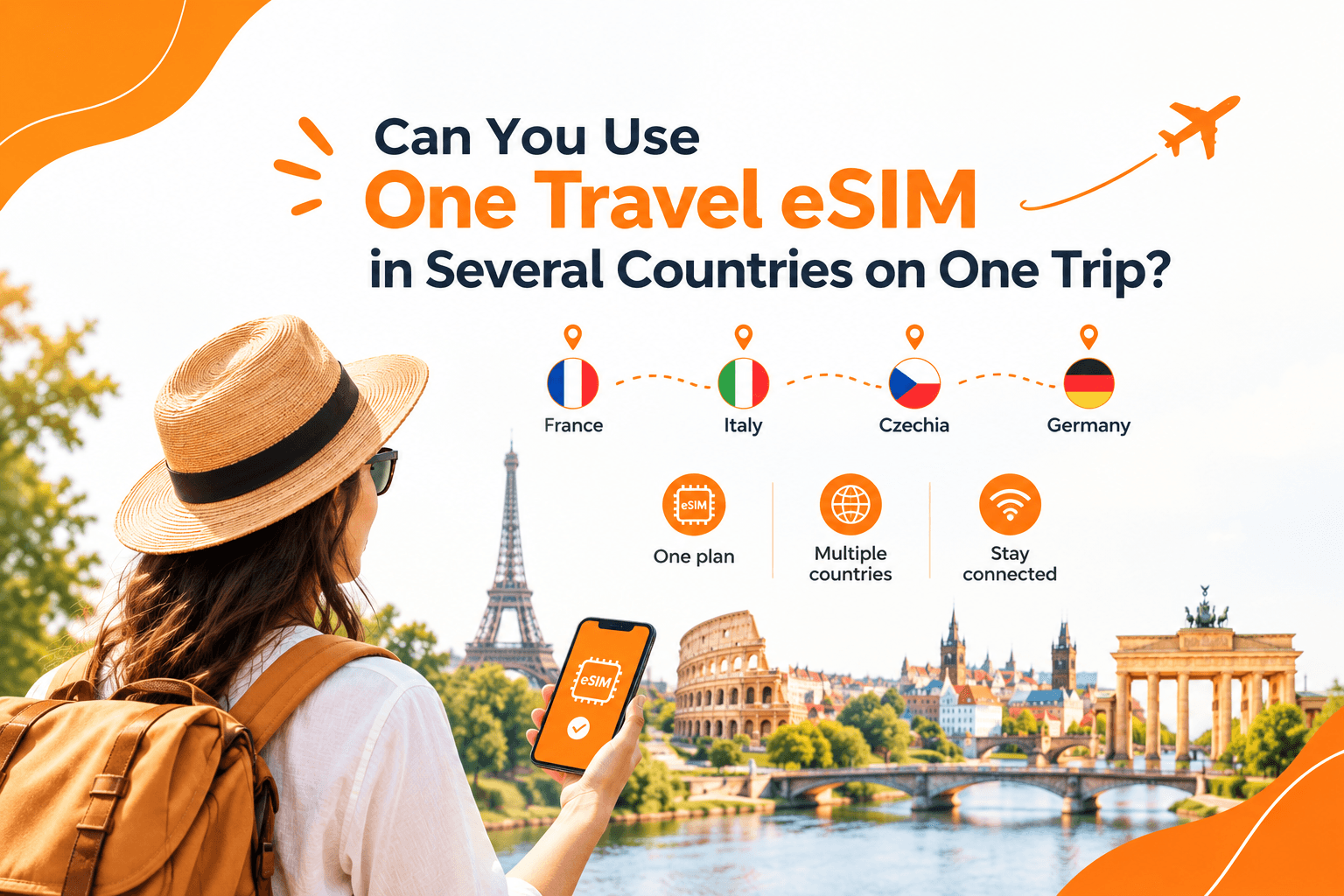
You land in Rome, take the train to Venice, then ride on to Vienna and Munich. By the second border you start to wonder if the eSIM on your phone still works. Or maybe you need to buy a new one at every stop.
Short answer
Yes. One travel eSIM can cover several countries, but only if it is a regional plan that lists every country on your route. A plan made for one country stops working at that country's border. Check the country list before you buy, install once at home, and your phone switches networks on its own as you cross.
How does one eSIM work in more than one country?
An eSIM is a SIM built into your phone, so there is no small plastic card to swap. Many people call it an eSIM card or an e sim, but nothing physical ever arrives. You install it by scanning a code on your screen.
A regional eSIM is one plan sold for a group of countries. When you cross a border, your phone joins a local mobile network in the new country. You do not scan anything again, and you do not buy anything new.
There are three kinds of travel eSIM, and the right one depends on your route.
| Question | One eSIM per country | Regional eSIM | Global eSIM |
|---|---|---|---|
| Best for | A long stay in one place | A route through neighbouring countries | A trip that crosses continents |
| How many to install | One for each country | One | One |
| At a border | You switch to the next eSIM by hand | Phone switches networks itself | Phone switches networks itself |
| Main risk | Forgetting to buy one before you cross | A country on your route is not on the list | Less data per country than you might want |
What does a multi-country trip look like with one eSIM?
Here is one ordinary route, followed leg by leg. It runs through Italy, Austria and Germany, with one regional eSIM on the phone the whole time.
At home, the week before
Install the eSIM while you are on home wifi. It takes a few minutes. Leave it switched off until you land, so nothing starts early.
Rome Fiumicino airport
Turn the eSIM on as the plane doors open. Your phone finds an Italian network while you queue at passport control. You need data straight away to find the Leonardo Express platform and the right exit at Termini station, about 32 minutes away.
Rome to Venice by fast train
The trip takes under four hours. Signal drops in the long tunnels in the hills near Bologna and Florence. Download your ticket and your hotel address before you board, so a dead patch does not matter.
Venice Santa Lucia station
There are no cars here, and the streets twist. You will open the map often, and you will want a water bus ticket on your phone. This is the leg where a weak connection gets annoying quickly.
The night train into Austria
You cross the border while you sleep. Your phone changes to an Austrian network by itself, and you are not asked to do anything. Some phones show a short banner naming the new network. Others show nothing at all.
Vienna to Munich
About four hours by train, and another border. Same thing again: the phone moves to a German network. By Munich Hauptbahnhof you should have full bars. If not, the fixes are below.
Flying home
Switch the travel eSIM off once you land, so your home line handles data again.
One eSIM, one setup, three countries. The only time you touched the phone was at the start and the end.
What should you check before you buy a regional eSIM?
Start with the country list. Regional plans name the countries they cover, and the list is the only thing that counts. For a route like the one above, a plan such as the Europe 33 Countries plan is built for this. Read its list and match it against every stop, including the ones you only pass through.
Then look at three more things on the plan page.
- Days. Count the days from your first landing to your last flight, not just the days you will use your phone heavily.
- Data. The data is one pot shared across every country on the plan. Ten days in one city and two days in the next draw from the same pot. Our guide to estimating data use abroad helps you pick a size.
- Your phone. It must support eSIM and be unlocked to use another network. The device list shows which models work.
The common slip is one stop outside the list. A side trip to a country the plan does not name means no data there, however good the plan is elsewhere.
When is one eSIM per country the better choice?
A regional plan is not always the answer. If you spend two weeks in one country and one day in the next, you may do better with a plan for the main country, plus a small second plan for the short stop.
Separate eSIMs also make sense when your route leaves the region. A trip that starts in Europe and ends in Asia needs a global plan, or two plans. You can keep both eSIMs on your phone and pick which one handles data in your settings.
Whichever you pick, buy before you fly. Looking for a local SIM at a station kiosk after a long journey is how people end up paying home-carrier roaming charges instead.
What if your phone has no signal after crossing a border?
Usually the phone just needs a minute. If bars stay empty, work through this list in order.
- Check that your travel eSIM is the line chosen for mobile data.
- Turn on data roaming for the travel eSIM line only. Data roaming means using a network other than the one the plan comes from, and the travel plan needs it on to work abroad.
- Keep data roaming off for your home line. That stops your home carrier charging you.
- Switch on airplane mode, wait ten seconds, and switch it off.
- Restart the phone.
Still nothing? Our guide on fixing no service after landing covers the rest.
The short version
A regional travel eSIM is the simplest way to cover a route through several countries. Match its country list to your stops, install it at home, and let the phone do the rest at each border. Where the route does not fit one region, use a second plan or a global one.


