


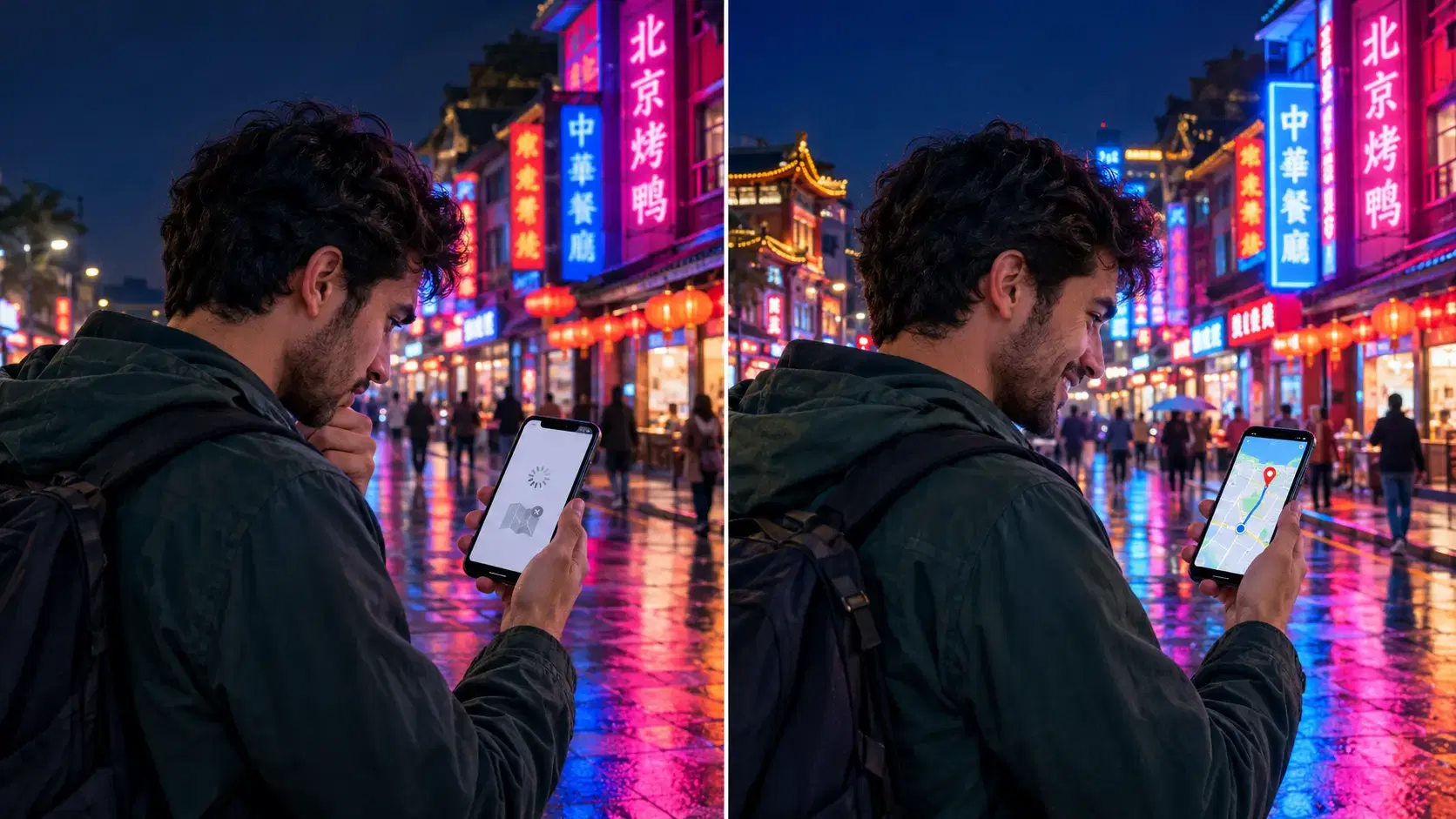
You land in Shanghai or Beijing, open WhatsApp to say you have arrived, and the message sits there with one grey tick. Nothing is wrong with your phone. Mainland China blocks WhatsApp, along with a short but very familiar list of other apps, and almost every first-time visitor hits this in the first hour.
What is actually blocked in mainland China
| Service | Status on a local network |
|---|---|
| Google Search | Blocked |
| Gmail | Blocked |
| Google Maps | Blocked |
| Blocked | |
| Blocked | |
| Blocked | |
| YouTube | Blocked |
| X (Twitter) | Blocked |
These sit behind what is commonly called the Great Firewall, China's nationwide system for filtering internet traffic. It applies to anyone connecting through a Chinese carrier or Chinese Wi-Fi network, tourist or not.
The apps people assume are blocked, but aren't
It is easy to lump every foreign app into the same blocked-in-China bucket, and that assumption is wrong often enough to cause real confusion. LinkedIn works normally in mainland China, on any network. So does Bing, where Google Search does not. Zoom's paid business tier generally works too, though its free consumer tier has had more hit-or-miss periods.
Locally, WeChat, Alipay and Baidu do the jobs WhatsApp, PayPal and Google Search do everywhere else, and almost everyone you meet will expect to add you on WeChat rather than exchange phone numbers.
Why a travel eSIM gets around the block, without a VPN
It works the same way your phone already handles a call when you are abroad: the signal connects to a local tower, but the call itself still routes back through your home network. A travel eSIM sends its data the same kind of way. It never joins a mainland Chinese carrier at all - the data goes out through a gateway outside China first, the way it would if you were still at home, so by the time it reaches Google or WhatsApp, China's filtering has nothing to check. That is the whole mechanism, and it is why this works without installing a VPN.
Do
Keep mobile data switched on from your eSIM for Maps, WhatsApp and the rest.
Do not
Switch to hotel or cafe Wi-Fi expecting the same apps to keep working - that connection runs through a mainland network, and the same block applies the moment you join it.
What an eSIM does not fix
A roaming eSIM gets you past the firewall, not past every restriction. Services like ChatGPT and several other AI apps limit mainland China on their own side, separately from the firewall, so they can stay out of reach even on a connection that otherwise opens Google and WhatsApp without trouble. If an AI assistant is part of your daily routine, it is worth checking whether it works from China before you rely on it there.
Buy it before you land, not after
Install your China eSIM before you fly, and leave the line switched off until you land. Most providers, including this one, will not let a phone already connected inside mainland China add a brand new eSIM profile - by then it is too late.
Test the eSIM on your home Wi-Fi before you leave, so you know the QR code installed correctly, then switch the line on only after you land.
Not every "China" or "Asia" eSIM routes this way
A cheaper eSIM advertised for China sometimes runs on a local Chinese carrier's own network to keep the price down, and that means it sits behind the same firewall as everyone else's local SIM. Before you buy, check specifically how the provider's China plan routes its data, not just whether the listing says China coverage.
Ask this before you buy
✓ Does this plan reach China through an international roaming partner, or a local Chinese network?
✓ Can I install and activate it before I land, not only after?
✓ Does it work the moment I land, or does it need a separate registration step first?
✓ Is there a simple way to top up from inside China if the trip runs long?
What it actually feels like on the ground
At the airport, your phone picks up the network as you clear immigration and Maps opens straight away. In the taxi into the city, a WhatsApp message to say you have landed sends normally. At dinner, when someone new wants to stay in touch, they will ask for WeChat, not your number - it is worth keeping the app installed even if you barely use it anywhere else, since it is how almost everyone in China actually communicates.
Travelling for a trade show
Large trade fairs bring in some of China's biggest spikes in foreign visitors, and Guangzhou's Canton Fair is the best known of them - we have covered what that trip looks like in detail. The same rule holds whether you are there for a show, a factory visit or a holiday: the apps you rely on work the same way, over the same kind of connection.
A phone that goes quiet the moment you land in China is one of the most common complaints from first-time visitors, and almost always it is the network, not the phone. Know which apps are actually blocked, which ones you have been needlessly worrying about, and have a working eSIM installed before you fly, and the rest of the trip runs the way it does at home.


