


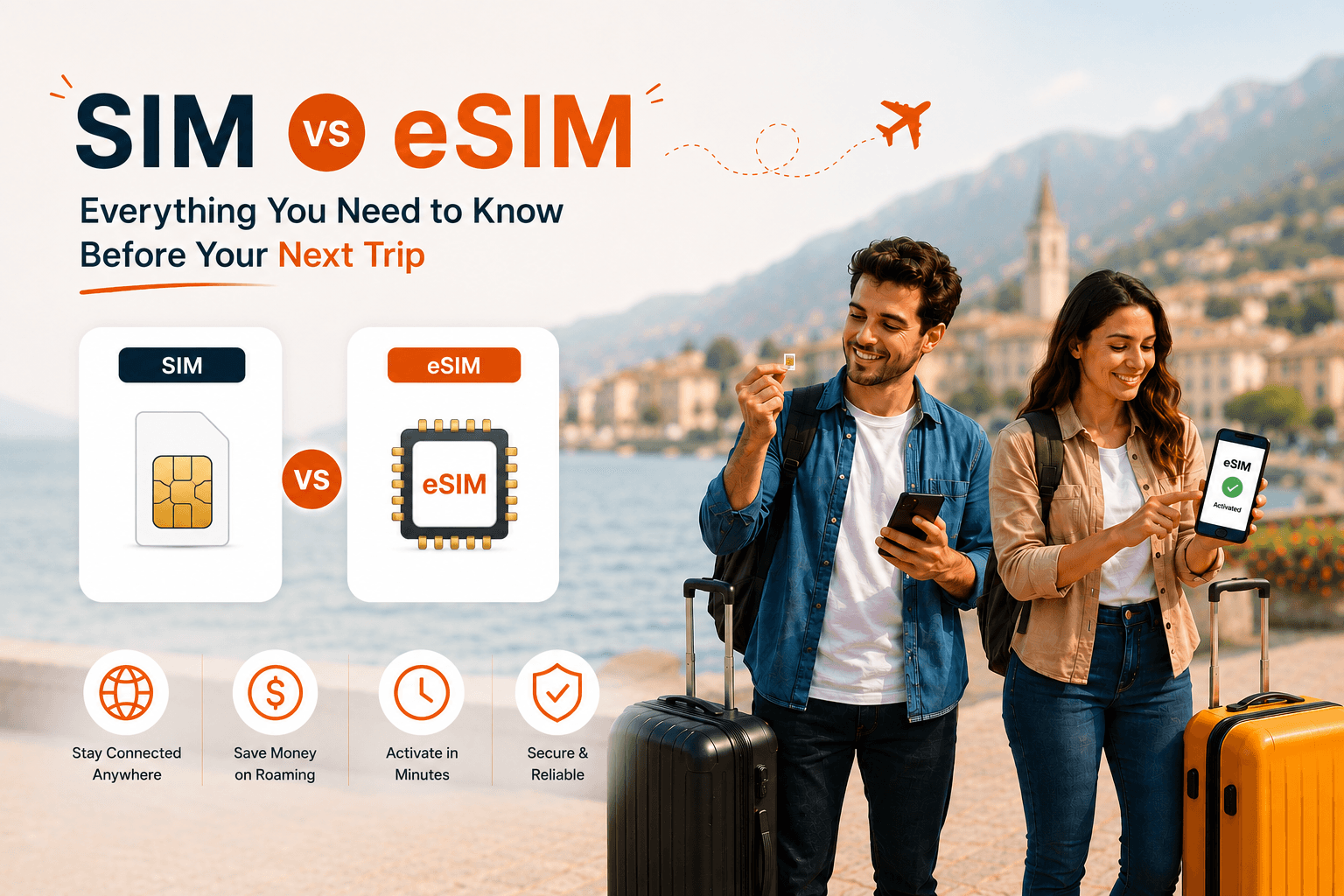
You are standing at the airport, bags checked, boarding pass in hand, and then it hits you, how are you going to stay connected once you land?
For years, the answer was simple: find a store, buy a SIM card, show your passport, wait for activation, and pray it works before you need Google Maps. That still works. But there is a faster, smarter option that millions of travelers are switching to every month.
This post breaks down the real difference between a regular SIM and an eSIM, who should use which, and how to make the right call before your next trip, whether you are heading abroad for a weekend or a month.
What is a SIM Card, Really?
A SIM card (Subscriber Identity Module) is the small plastic chip you physically slide into your phone. It holds your mobile identity, your number, your plan, your network connection. When you travel internationally, your home SIM still works, but your carrier charges you roaming fees that can get shockingly expensive.
The workaround most travelers have used forever is buying a local SIM at the destination. It is cheap, it works on local networks, and you get a temporary local number. The catch? You have to be physically present to buy one, you need documents for verification in many countries, and you have to remove your current SIM and store it somewhere safe, which is where a lot of people lose it.
What is an eSIM?
An eSIM (embedded SIM) is not a physical card at all. It is a chip built directly into your phone that can hold multiple operator profiles digitally. Instead of inserting a piece of plastic, you scan a QR code or tap through an app, and your plan is live in minutes.
Your phone already supports eSIM if it was manufactured after 2018. That includes every iPhone from the XR onwards, Samsung Galaxy from the S20 series, Google Pixel 3 and newer, and most flagship Android devices released since 2020. To confirm, look for an "EID" number in your phone's settings, that is your eSIM identifier.
The biggest practical difference from a regular SIM: you do not swap anything. You can run your home SIM and a travel eSIM at the same time. Your Indian number keeps receiving calls and WhatsApp messages on your home SIM while your eSIM handles data at local rates on a foreign network.
SIM vs eSIM: The Honest Comparison
Getting Connected
With a physical SIM at a foreign destination, you typically need to visit a telecom store or airport kiosk, show your passport, fill out forms, and wait anywhere from 30 minutes to a few hours for activation. Some countries, like India, have strict verification requirements, address proof, passport copies, and sometimes a call back for confirmation.
With an eSIM, you buy online before you even pack your bags. The QR code lands in your email. You scan it from your couch. When your flight lands, you already have working data.
Your Home Number
Swapping to a local SIM means your regular number is unreachable unless someone calls your new temporary number, which nobody knows. Important OTPs, bank alerts, and family calls all go to a SIM sitting in your luggage. Miss one OTP for a transaction and you understand why this matters.
An eSIM lets you keep your home SIM active. Calls and SMS come in normally. You use the eSIM purely for data, and apps like WhatsApp, Skype, and Google Maps run off that data connection without interruption.
Cost
This is where the conversation gets nuanced. Local SIM cards bought in the destination country are almost always cheaper per gigabyte than travel eSIMs from third-party providers. If you are staying in India for 84 days, a Jio or Airtel physical SIM plan will beat any international eSIM on pure data cost.
But for trips of a few days to four weeks, the math changes. Once you factor in taxi fare to the store, time spent waiting, the risk of activation delays, and the convenience of zero paperwork, a travel eSIM at a slightly higher per-GB cost is almost always worth it.
Flexibility
Physical SIM cards are one network, one plan. If you travel to three countries in two weeks with a physical SIM from country one, you are roaming again from day two.
eSIM providers offer regional plans that cover multiple countries under one purchase. Travel across Europe, Southeast Asia, or the Middle East without buying a new SIM at every border.
Environmental Impact
This is rarely talked about but genuinely matters. Every plastic SIM card that gets used for a week and thrown away is electronic waste. eSIMs eliminate that entirely. No plastic, no packaging, no disposal problem.
When a Physical SIM Still Makes Sense
eSIMs are not for everyone in every situation.
Here is when sticking to a physical SIM is the smarter call:
Your phone does not support eSIM: If you are using a device older than 2018, or a budget Android model that skipped eSIM hardware, a physical SIM is your only option. No workaround exists.
You are staying for more than two months: Local carrier plans in countries like India offer truly unlimited data at costs that are hard for any international eSIM to match. Long-term residents and digital nomads usually switch to a local SIM once settled.
You need a local phone number: Travel eSIMs are almost always data-only. If you need to receive calls on a local number, for booking services, local banking, or receiving region-specific OTPs, a physical local SIM is necessary.
You are in a remote rural area: In very remote parts of any country, a local carrier SIM on the dominant local network will often outperform a travel eSIM that roams on a partner network, which may be prioritized lower during congestion.
When eSIM Wins Every Time
Short international trips from 3 days to 6 weeks: Set up before you fly, active the moment you land, no paperwork, no queues.
Multi-country itineraries: One plan covering your entire route beats buying local SIMs in four countries.
Business travel where time is money: A 45-minute queue at a Narita or CDG telecom kiosk is 45 minutes not spent preparing for your meeting.
Travel to countries with bureaucratic SIM processes: Countries with strict foreign registration requirements, and India is a good example when you are the incoming traveler, make travel eSIMs a genuinely practical relief.
Dual-SIM users who want both numbers active: Your home SIM stays live. Your travel eSIM handles data. You never miss a call, never lose an OTP.
How eSIM Activation Actually Works
The process is simpler than most people expect.
Here is what it looks like:
- You pick your destination and a data plan from an eSIM provider's website or app.
- You pay online. A QR code is sent to your email within minutes.
- Go to your phone settings. On iPhone: Settings > Cellular > Add eSIM. On Android: Settings > Network > SIM > Add eSIM.
- Scan the QR code.
- Your eSIM profile is installed. You can activate it immediately or set it to activate when you land.
That is it. The whole process takes under five minutes. No store visits, no documents, no waiting.
What Indian Travelers Need to Know Specifically
Indian travelers have a unique situation worth addressing. Going abroad, your Jio, Airtel, or Vi plan offers international roaming, but the costs are steep. A Jio international pack, for example, gives you roughly 500MB to 3.5GB over 7 days at rates that can run to several hundred rupees per gigabyte. Exceed the pack limit and you can face per-MB charges that compound into surprisingly large bills.
A travel eSIM from a reliable provider typically gives you far more data for the same budget, with transparent pricing and no bill shock. The data is yours upfront. You spend exactly what you paid, nothing more.
The dual-SIM advantage also matters specifically for Indian users: UPI transactions, Aadhaar OTPs, and family WhatsApp groups all stay active on your Indian number while your eSIM handles navigation, work calls over data, and everything else abroad.
Choosing the Right eSIM Provider
Not all eSIM providers are equal.
Things that actually matter when comparing options:
Coverage network: Which local carrier does the eSIM connect through at your destination? On-ground network quality varies enormously. A provider connecting through a top-tier carrier at your destination makes a real difference in speed and reliability.
Plan flexibility: Can you choose between daily, weekly, and monthly plans? Can you top up mid-trip without buying a completely new eSIM profile? Flexibility matters on longer or open-ended trips.
Ease of installation: The QR code method works on every compatible phone. Providers with clear step-by-step guidance reduce confusion significantly, especially for first-time eSIM users.
Customer support: If something goes wrong mid-trip, activation issues, unexpected cutoffs, or compatibility questions, you need support that responds quickly. Slow or unavailable support during a trip is a serious problem.
Transparent pricing: No hidden fees, no surprise roaming charges on top of the plan, no automatic renewals you did not agree to.
Olysim covers all of these bases. It offers plans across 150+ countries and regions, with 4G and 5G connectivity depending on availability at your destination. Plans run from daily to monthly to unlimited options, so whether you are on a four-day work trip to Dubai or backpacking Southeast Asia for six weeks, there is a plan that fits. Activation is a single QR code scan, and their app lets you manage data usage and top up without digging through settings. Travelers who have used Olysim consistently mention two things: how clean and fast the activation is, and how responsive the support team is when questions come up. For Indian travelers heading abroad who want a set-it-and-forget-it connectivity solution, it is a genuinely solid option worth checking out at olysim.com.
Checking eSIM Compatibility on Your Phone
Before you buy any eSIM plan, confirm your device supports it:
iPhone: Go to Settings > General > About. Scroll to find "Available SIM" or "EID." If an EID number appears, you are compatible. iPhones from XR (2018) onward all support eSIM.
Samsung: Settings > About Phone > Status Information > look for EID. Galaxy S20 and newer support eSIM. Note: Some Galaxy models sold in certain markets came without eSIM, check your specific model.
Google Pixel: Settings > About Phone > SIM status. Pixel 3 and newer are compatible.
Other Android devices: Dial *#06# on your keypad. If an EID number appears alongside the IMEI, eSIM is supported.
One more thing, your phone must be unlocked. A carrier-locked phone may not accept eSIM profiles from other providers even if the hardware supports it. Check with your carrier if you are unsure.
The Question Everyone Asks: Is eSIM Secure?
The short answer is yes, and in some ways more secure than a physical SIM.
A physical SIM card can be removed, cloned, or used in SIM-swap fraud, where someone tricks your carrier into transferring your number to their device. This is one of the most common methods used in account takeovers tied to phone-number-based authentication.
An eSIM profile is stored as encrypted data on your device. It cannot be physically stolen. Switching the profile to another device requires authenticated authorization through the carrier, not just possession of a card. For business travelers and people who rely on their phone numbers for sensitive two-factor authentication, this is a meaningful security advantage.
The Bottom Line
SIM cards work. They have worked for decades and they will keep working. But eSIM removes every friction point that makes staying connected abroad more stressful than it needs to be, the queues, the paperwork, the lost SIM tray pin, and the roaming bill at the end.
For most travelers heading abroad for a few days to a few weeks, an eSIM from a reliable provider is simply the smarter move. Set it up before you leave, keep your home number active, and land with working data already in your pocket.
If you have not tried it yet, your next trip is a good time to start. Visit olysim.in to browse plans for your destination, it takes less time than a coffee queue at the airport.


