


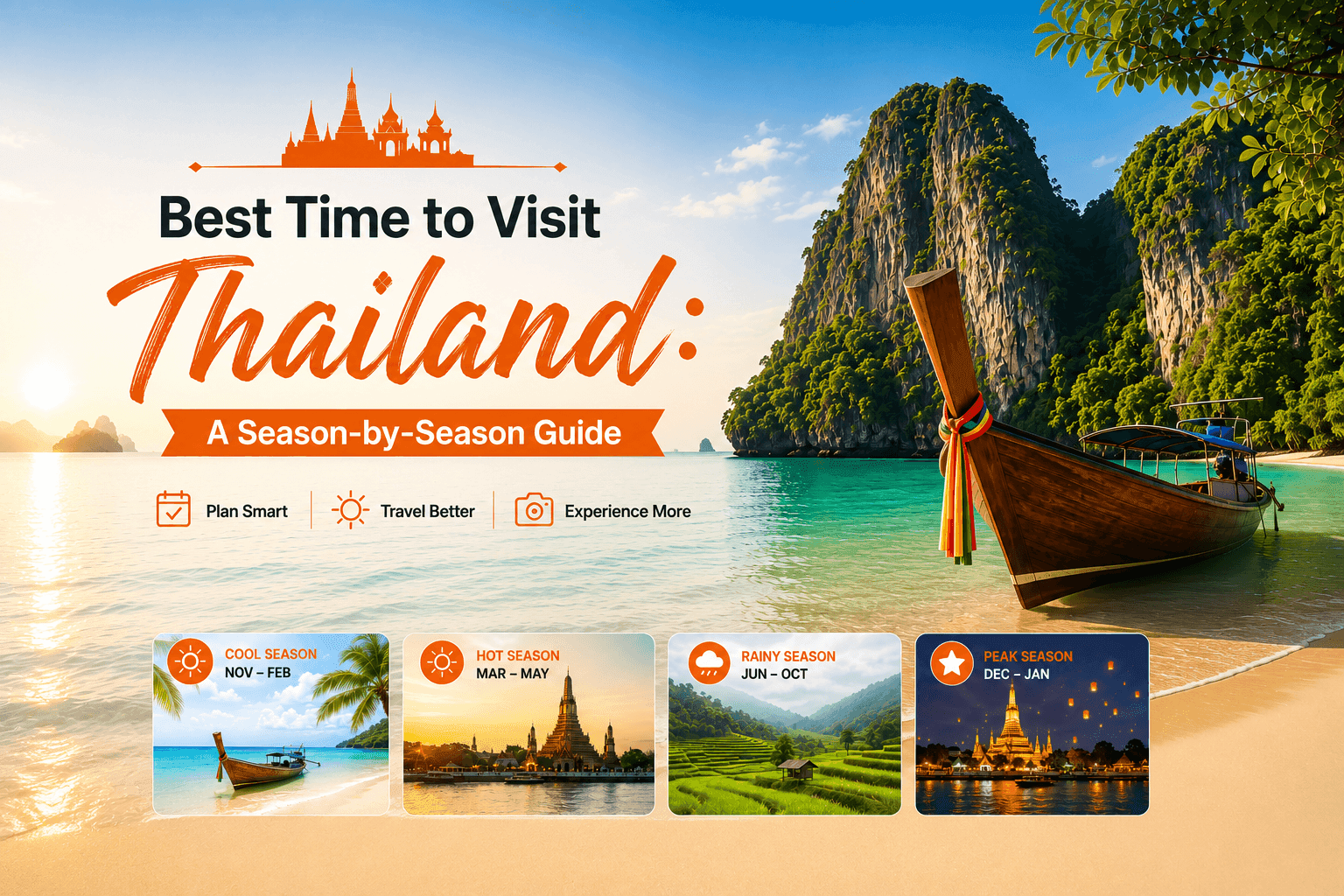
If you ask ten different travel sites when to visit Thailand, you'll get the same answer ten times: November to February. That's not wrong, but it's only half the story. Thailand is shaped like a long, narrow spine running from the mountains near Myanmar down to the beaches near Malaysia, and the weather that's perfect in Chiang Mai can be miserable on Koh Samui the very same week. The "best" time really depends on which Thailand you're going to see, and, if you're travelling from India, on a few 2026-specific things that older guides simply don't mention.
Here's the version of this guide we wish existed before we started planning.
The Short Answer
November through February is Thailand's cool, dry season, and it's the safest bet for a first trip. Humidity drops, skies clear up, and you can move between Bangkok's temples, Chiang Mai's hills, and the southern islands without fighting rain or heat exhaustion. It's also, unsurprisingly, when hotel prices peak, and beaches get crowded.
But that four-month window isn't the only good option, and depending on what you actually want from the trip, it might not even be the best one for you.
Thailand Has Three Seasons, Not Two
Most people think in terms of "dry" and "rainy." Thailand actually runs on three:
Cool season (November to February): The most comfortable stretch nationwide. Daytime temperatures sit in a pleasant 25 to 32°C range, nights in the north can dip into the teens, and rainfall is minimal almost everywhere.
Hot season (March to May): Temperatures climb fast, often crossing 38 to 40°C in Bangkok and the central plains by April. This is also when Songkran, the Thai New Year water festival, takes over the entire country in mid-April. If you can handle the heat, this is a genuinely fun (if chaotic) time to be here.
Rainy season (June to October): The southwest monsoon brings short, heavy afternoon downpours rather than all-day rain. Landscapes turn a deep green, crowds thin out, and prices drop noticeably. September is usually the wettest month overall.
Here's the part that trips people up: the east and west coasts of southern Thailand run on opposite rain schedules. Phuket, Krabi, and the Andaman coast get their heaviest rain roughly from May to October. Koh Samui, Koh Phangan, and the Gulf coast see their wettest stretch later, mainly from October to December. So if you're flexible about which beach you're headed to, there's almost always a sunny coastline somewhere in the country.
The Thing Most Guides Skip: Chiang Mai's Burning Season
This is the detail that separates a well-researched itinerary from a copy-pasted one, and it genuinely matters if temples and mountain scenery are on your list.
Every year, from roughly mid-February through April, farmers across northern Thailand (and neighbouring Laos and Myanmar) clear fields using slash-and-burn agriculture. Combined with dry-season wildfires, this creates a thick haze that settles over Chiang Mai, Chiang Rai, and Mae Hong Son. Air quality regularly hits "unhealthy" or worse on the AQI scale, and Chiang Mai has landed at the top of the global most-polluted-city rankings during particularly bad weeks in past years.
The practical takeaway: if temple-hopping in Chiang Mai and mountain views of Doi Suthep are the whole point of your trip, plan for November through January. If you're set on visiting in March or April anyway (maybe for Songkran), keep an eye on real-time AQI apps, limit strenuous outdoor time on bad days, and consider that Bangkok and the southern islands are largely unaffected, so you can shift your itinerary south during the worst weeks.
Best Time by the Kind of Trip You Want
For temples, culture, and city exploring: November to February. Cooler air makes walking around Bangkok's Grand Palace or Ayutthaya's ruins far more enjoyable, and you avoid the northern haze entirely.
For beaches and island hopping: December to March covers both coasts reasonably well. If you're set on the Andaman side (Phuket, Krabi, the Similan Islands), November to April is your calmest, clearest window. If Koh Samui or Koh Phangan is the plan, July and August actually work better than the winter months, since Samui's wet season peaks later in the year.
For diving and snorkelling: November to April on the Andaman coast, when the sea is calm, and visibility is at its best.
For festivals: Songkran (mid-April) turns the entire country into a nationwide water fight, genuinely one of the most memorable experiences you can have in Southeast Asia, if you don't mind the heat. Loy Krathong (usually in November) is quieter and more atmospheric, with thousands of floating lanterns released along rivers and, in Chiang Mai, into the night sky.
For budget travel: May to June and September to early November. Rain is manageable, crowds are thin, and hotel and flight prices often drop by a meaningful margin compared to peak season.
What's Different for Indian Travellers in 2026
This is the part that's changed recently enough that a lot of older "best time to visit" content is now outdated, and it directly affects how you should plan a Thailand trip from India this year.
For a couple of years, Indian passport holders enjoyed visa-free entry to Thailand for up to 60 days. That changed in 2026. Following a Thai Cabinet decision in May, India was moved out of the visa-free category and back into the Visa on Arrival (VoA) group, along with a small handful of other countries. Under the current rules:
- Visa on Arrival gets you a maximum stay of 15 days, costs around 2,000 THB (roughly ₹5,000 to ₹6,000), and must be paid in Thai Baht cash at the airport counter.
- Tourist e-Visa, applied for online before you fly, grants 60 days and can be extended once at a Thailand immigration office. This is the better option for anyone planning more than a short trip.
- Thailand Digital Arrival Card (TDAC) is now mandatory for every traveller, regardless of visa type. You fill it out online within 72 hours of arrival and get a QR code that immigration checks on landing. It's free, but skipping it can mean being denied boarding by your airline.
- Indian travellers should also carry proof of funds, generally cited as 10,000 to 20,000 THB per person, along with confirmed return tickets and hotel bookings. The Indian Embassy in Bangkok has been actively advising travellers to keep all of this documentation easily accessible at immigration.
None of this makes Thailand harder to enjoy; it just means the old "book a flight and go" spontaneity needs a bit more preparation than it used to. Sort your visa route and TDAC before you leave home, and the actual holiday is unaffected.
On the flight side, connectivity from India remains excellent. Delhi to Bangkok runs around 4 hours 20 minutes non-stop on multiple carriers, and several Indian cities, including Mumbai, Bangalore, Chennai, and Pune, have direct Bangkok flights too. If beaches are the priority, Delhi to Phuket directly takes roughly 4 hours 40 minutes, cutting out a domestic connection through Bangkok entirely.
Planning Around Indian Holidays
Since most Indian travellers work around a limited set of holiday windows, it's worth matching those against Thailand's seasons rather than picking dates in isolation:
Diwali and the following weeks (October to November): This lands right at the tail end of the rainy season. Expect occasional showers but generally improving weather, thinning rain, and noticeably fewer crowds than during the December rush. A genuinely good value window.
Christmas and New Year: This is peak season in every sense, best weather, biggest crowds, highest prices. Book well in advance if this is your only window.
Summer holidays (April to June): This overlaps with Thailand's hottest months, and April specifically is Songkran season. Great if you want the festival experience and don't mind the heat; less ideal if you're travelling with young kids or elderly parents who struggle in high temperatures.
Before You Fly: A Quick Prep Checklist
A few practical things worth sorting before departure, based on everything above:
Documents: Passport valid for at least 6 months, TDAC completed within 72 hours of arrival, confirmed hotel bookings and return tickets, and cash in Thai Baht for the VoA fee if you're not going the e-Visa route.
Money: Exchange a small amount before you leave India for immediate cash needs, and rely on ATMs or cards for the rest. Keep the VoA fee amount specifically in Baht cash, since counters don't accept rupees, dollars, or cards for it.
Staying connected: This one's easy to overlook until you're standing at Suvarnabhumi Airport at midnight trying to book a Grab ride with no signal. Given that TDAC needs a working internet connection to complete (and immigration officers may ask to see it on your phone), landing without data isn't a great start to the trip. An eSIM sorted before you leave home solves this cleanly: no queueing at an airport SIM counter, no roaming shock on your India number, and it's active the moment you land. Olysim's Thailand eSIM plans run from a 2-day pack up to a full month, with unlimited data options starting under $5, and the whole thing activates by scanning a QR code, so there's genuinely nothing to pick up at the airport. If your trip also includes a Singapore or Malaysia leg, Olysim's regional eSIM covers all three countries on one profile, which is handy if you're doing a longer Southeast Asia circuit rather than just Thailand.
Health and comfort: If your dates fall in February through April and Chiang Mai is on the itinerary, pack an N95 mask and check real-time AQI before committing to outdoor plans that week.
The Bottom Line
November to February remains the safest, most comfortable window for a first-time trip to Thailand, covering temples, beaches, and cities without fighting extreme heat, heavy rain, or northern haze. But "best" genuinely depends on your priorities: chase Songkran in April if you want the festival, head to Koh Samui in July if you want a rain-season workaround, or travel in October if you want thinner crowds without giving up good weather.
What's changed for 2026 is less about the weather and more about the paperwork. Indian travellers now need to plan their visa route (VoA or e-Visa) and complete the TDAC in advance, rather than relying on the visa-free entry that was available until earlier this year. Sort that piece early, along with your connectivity, and the rest of the trip runs exactly as smoothly as Thailand always has.


