


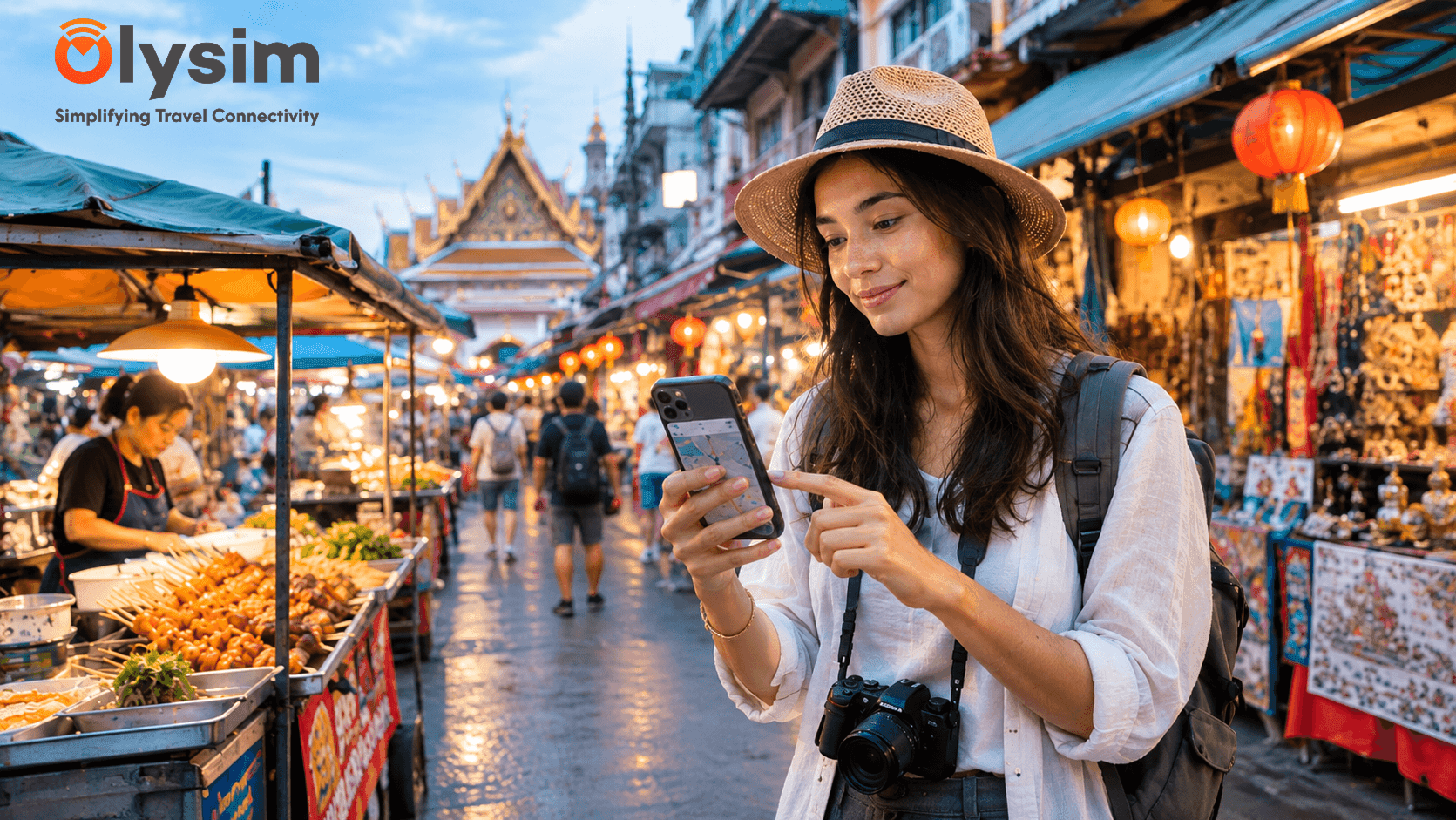
What's the Best Way to Get Mobile Data in Thailand?
For most visitors, an eSIM is the simplest choice. An eSIM is a SIM built into your phone, so there is no small plastic card to swap. You buy a data plan for Thailand before you fly, turn it on when you land, and you're online without a stop at a phone counter.
That matters in a country where you'll likely lean on your phone constantly, whether it's ride-hailing apps to get around Bangkok's traffic, translation for a market stall in Chiang Mai, or maps to find your way between islands. You can see current plans for Thailand on the Olysim Southeast Asia eSIM page, or browse all destinations on the plans page.
Why Roaming Gets Expensive Fast in Thailand
Roaming means using your home phone plan while you are in Thailand. Your carrier lets your phone connect to a Thai network, then charges you for it - often by the day or by the megabyte used.
A short layover in Bangkok might be fine on roaming. But a two-week trip covering Bangkok, Chiang Mai and a few islands almost always costs less on a local data plan. Our guide on whether an eSIM is cheaper than roaming breaks down why.
Does My Phone Support an eSIM in Thailand?
Most phones from the last few years do. Recent iPhones, Samsung Galaxy phones and Google Pixel phones almost all support eSIM. Check your exact model on our eSIM compatible device list before you buy a plan.
If your phone is older and doesn't support eSIM, a physical SIM card bought locally is still a reasonable backup. Bangkok's airports and shopping malls have plenty of phone shops.
Coverage: Cities, Beaches and Islands
Coverage in Bangkok, Chiang Mai, Phuket and other major tourist areas is generally strong and fast. Thailand's mobile networks are well built out compared to many countries in the region.
- Popular islands like Koh Samui and Koh Phangan usually have solid coverage in main towns and beach areas.
- Smaller or quieter islands can have weaker signal once you're away from the main pier or resort strip.
- Remote national parks and mountain areas in the north can have patchy coverage, similar to rural areas anywhere.
This is true for every network in Thailand, local or foreign, so it's not something an eSIM changes. Download offline maps before a day trip to quieter islands or mountain routes.
The key takeaway: an eSIM gives you the same coverage a local SIM would, which is strong across most of Thailand's popular tourist areas. Just plan for gaps on quieter islands and in remote mountain regions.
How Much Data Do You Need for a Thailand Trip?
| Trip Style | Typical Use | What You'll Rely On |
|---|---|---|
| Short city break | Maps, messaging, some photos | A small data plan, plus hotel wifi |
| Multi-city and island trip | Ride-hailing apps, translation, ferry and flight bookings | A mid-size plan covering your full stay |
| Backpacking or long stay | Heavy daily use, video calls home, streaming | A larger plan, or topping up partway through |
Compare data sizes and trip lengths on the Olysim plans page and pick the one closest to how you actually plan to use your phone.
Setting Up Your Thailand eSIM Before You Fly
Do this before you leave, while you still have reliable wifi at home:
- Choose a Thailand data plan on the plans page.
- Install the eSIM using the QR code you receive, following our install guide.
- Leave the eSIM line turned off until you land, so it doesn't try to connect early. See our guide on when your eSIM plan actually starts for more on timing.
- Turn off data roaming on your home SIM, so your home carrier can't charge you as well once you land.
Will My Phone Number Still Work?
Yes. Your normal phone number stays on your regular SIM the whole time. The eSIM simply adds a second line for data, so you can still receive calls and texts on your usual number while browsing on your Thailand plan.
Visiting Other Southeast Asian Countries Too?
If your trip also includes Singapore or Malaysia, a single regional plan can save you buying a new eSIM at every border. The Singapore, Malaysia and Thailand plan is built for routes like this, and the Asia Max plan covers a wider region if you're travelling further.
The Bottom Line
For Thailand, an eSIM is usually the easiest and cheapest way to stay connected, with coverage that matches a local SIM across most cities, beaches and islands. Just plan for signal gaps on quieter islands or remote mountain routes, the same as you would with any SIM.
Browse Thailand eSIM plans and get set up before you fly on the Olysim plans page.


